
Skibchaam: The Feared Red Snake of Shergaon
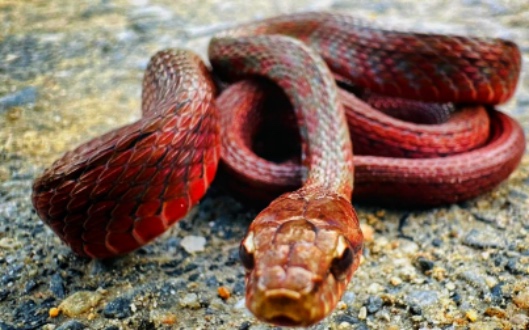
For generations, the Sherdukpen community of Shergaon, Arunachal Pradesh, has spoken of Skibchaam, a feared reddish snake believed to be highly venomous. During field surveys, an investigation into these accounts led to an unexpected discovery: the snake identified by local residents was the non-venomous Sikkim keelback (Herpetoreas sieboldii). This story explores the fascinating intersection of local knowledge, folklore, and scientific understanding, revealing how fear and lived experience shape human relationships with wildlife.
Skibchaam: The Feared Red Snake of Shergaon
Skibchaam: The Feared Red Snake of Shergaon
High in the forested slopes of Shergaon in West Kameng, Arunachal Pradesh, mist clings to pine needles, moss covers stone walls, and streams carve their way down quiet valleys. It is a peaceful place—until someone mentions the name Skibchaam.
Among the Sherdukpen people, Skibchaam is no ordinary snake. Its name is spoken with caution, sometimes even fear, but never casually. According to local accounts, Skibchaam is a red-coloured, highly venomous snake that hides near the water's edge and strikes without warning.
During our herpetofaunal surveys in Shergaon, stories of Skibchaam surfaced almost everywhere—around kitchen fires, over cups of salted butter tea, and in casual evening conversations.
“If Skibchaam bites you,” an elderly man warned, “you will not make it back to the village.”
Another villager claimed to have lost a cow to its bite. Parents told their children not to wander near streams after dusk. For the Sherdukpen, Skibchaam was more than a snake; it was a danger woven into everyday life.
The name itself was described as referring to a deer-coloured snake, yet people consistently spoke of a reddish-brown body and a reputation for deadly bites. Given how consistently these accounts emerged, we wanted to understand which snake the community was describing.
Armed with field guides, cameras, and curiosity, we began asking more questions. The more we heard, the more mysterious the snake became. We started collecting photographs of red or reddish-brown snakes from the region and beyond. We sat with elders and went through the images one by one.
“Is this Skibchaam?”
“No.”
“This one?”
“No, Skibchaam's colour is deeper, more red—and this one is smaller.”
No matter what we showed them, the villagers shook their heads. None of the photographs matched their description. By this time, we were increasingly curious about the identity of the snake that had occupied such a powerful place in local accounts.
We searched deep into the forests of Shergaon. We crossed streams, climbed slippery slopes blanketed in oak and rhododendron, and followed winding paths beside cold mountain water. The forest floor was damp and quiet, broken only by the sounds of hidden streams.
Despite days of searching, we saw nothing. Each evening, sitting back at camp, we wondered whether the snake was simply folklore—a cautionary tale passed down through generations to keep children safe from water hazards and other dangers.
Just when we were beginning to lose hope, everything changed.
We were following a shaded stream deep inside the forest when we spotted a slender snake basking on a moss-covered boulder. Its scales shimmered in muted shades of olive-brown, with a reddish tint, just as the villagers had described. For a moment, it stayed motionless, perfectly camouflaged against the wet stone.
As soon as it detected us, it quietly slipped into the stream and vanished beneath the rocks. As if it had never existed, it was gone.
Fortunately, we managed to take a few photographs before it disappeared.
Back in the village, we showed the photographs to the elders. The response was immediate. One individual firmly pointed to the picture and said, “Yes. This is Skibchaam.”
We were thrilled, but also confused. The snake did not look like any of the highly venomous species we had considered. That night, we sat under the glow of our headlamps, going over photographs, scale information, and field-guide references. After hours of checking and rechecking, the answer emerged.
The snake feared across Shergaon for generations—believed to be a deadly red killer—was actually the Sikkim keelback, Herpetoreas sieboldii.
A non-venomous, semi-aquatic snake, the Sikkim keelback inhabits cold mountain streams and feeds mainly on fish, tadpoles, and frogs. It poses no venom-related threat to humans and plays an important role in maintaining the balance of freshwater ecosystems.
Even after we explained its harmless nature, many villagers remained unconvinced. To them, Skibchaam was dangerous—not necessarily because they had personally witnessed an attack, but because they had learned to treat snakes as potentially lethal. In a remote region like Shergaon, where medical help may be far away, caution can be a matter of survival.
Over time, fear had become folklore, and folklore had become firmly rooted in the community's understanding of the snake. Such beliefs are shaped by generations of experience, stories, uncertainty, and the need to stay safe in a landscape where encounters with wildlife are part of everyday life.
Finding Skibchaam was therefore about more than recognising a snake. It offered a reminder of how scientific knowledge, cultural beliefs, and local knowledge interact—sometimes conflicting, sometimes complementing one another.
To science, Skibchaam is the Sikkim keelback: a non-venomous, elusive, and fascinating snake. Yet in the collective memory of the Sherdukpen community, its name continues to carry the weight of whispers, caution, and fear.
And perhaps that is fitting. In the mist-covered forests of Shergaon, where every stream seems to hide a secret, some stories continue to live on even after the facts are finally known.
For welcoming us into their homes and sharing their stories, we extend our sincere gratitude to the Sherdukpen people of Shergaon. Their warmth, hospitality, and knowledge of the land made this investigation possible.
We are deeply grateful to Mr. Girish Choure for his constant guidance, encouragement, and support throughout this work. We also thank the Wild Lands Division of the Wildlife Trust of India for its support. Our sincere thanks go to Arunima Haridas, who worked alongside us in the field, sharing the long treks, countless discussions, and quiet moments beside the streams that shaped this journey.
Shaillendra Singh Deora